SANA MUSASAMA
(b. 1957, Queens, NY; lives and works in Queens, NY)
Sana Musasama is a Black feminist artist and activist whose ceramics are shaped by global travel and humanitarian work with women and girls in Cambodia, West Africa, and beyond. A graduate of The City College of New York and Alfred University, her practice blends cultural symbolism with themes of healing and resilience. She has worked with the Somaly Mam Foundation and developed the “Apron Project” to support survivors of trafficking. Her work has been exhibited at the Studio Museum in Harlem and The Everson Museum of Art and collected by the Cooper Hewitt and the Museum of Arts and Design.
Children’s Art Carnival affiliation: Teaching Artist, circa 1970s

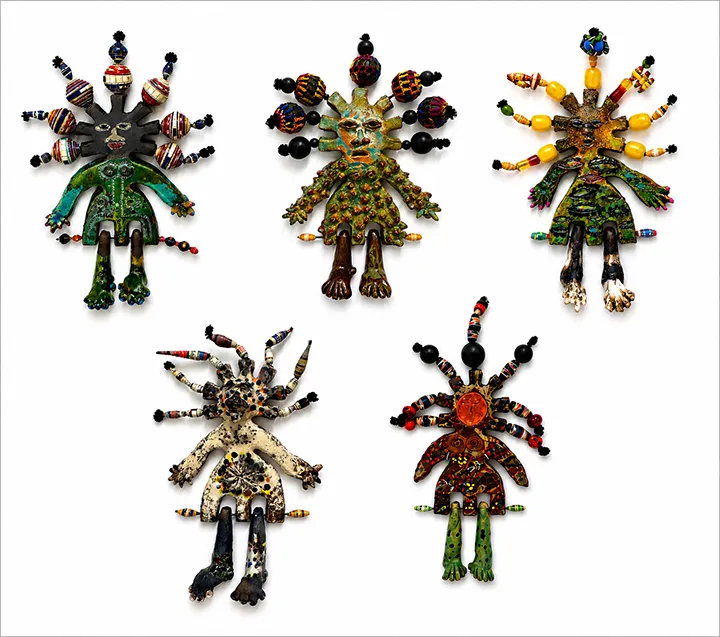
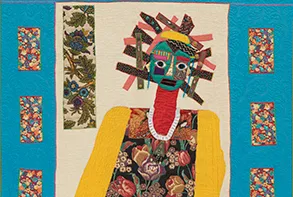
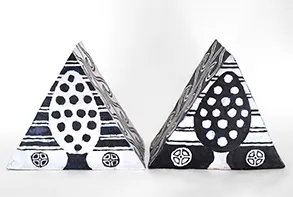
I See Me Dolls (I-V), 2023–26
Ceramic with mixed media
Dimensions vary; each approx. 9 × 6 × 1 ½ in.
Courtesy of the artist
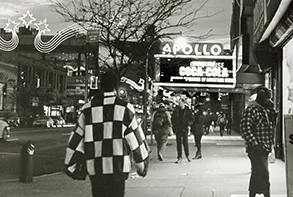
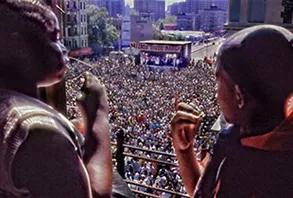
Sana Musama’s experience at the Carnival, which she likened to “world travel underneath one roof,” shaped her commitment to celebrating diversity. “Our common ground was being brown people, our common ground was our multi-material, our common ground was our love of Africa. Our common ground was our identity…It was, like, a very big stepping stone to have that kind of experience as a young artist.”
Confronting America’s history of systemic attempts at Black erasure—particularly during enslavement, when some historians believe Black children were either prohibited from having dolls in their own image or given only racist caricatures—Musasama created this series (2023–26) of ceramic dolls, which she describes as “a celebration of identity.”
The works are reinterpretations of a doll the artist’s mother made when she was a child, to help her appreciate her own natural Black beauty. Rejecting White supremacist ideals of beauty and style, Musasama fashions dolls with Black phenotypes and hairstyles that reflect both her own image and those of people within her community. Pipe cleaners and beads arranged into spiky hairstyles reference woolly and kinky hair textures, while the dolls’ ceramic bodies of varied colors evoke the broad spectrum of skin tones found throughout the Black diaspora.
MINI ORAL HISTORY