MILAGROS BATISTA
(b. Puerto Plata, Dominican Republic; lives and works in New York, NY)
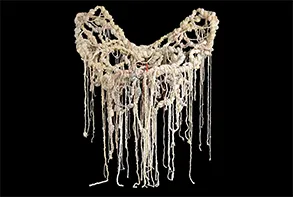
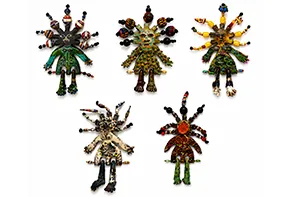
Milagros Batista credits her birthplace and surroundings for grounding her, honing her style, and captivating her imagination. The sheer beauty and power of her childhood surroundings left very strong impressions: music and the sounds of the ocean, a dazzling palette, the movements and ways of the people, the smell of coffee, sugarcane, rum, mangoes, and wild fruits in the air; and the beauty and power of the Caribbean sea. As a child, she drew inspiration from the strong women around her. From her mother, she acquired strength, from her maternal grandmother, she learned the value of independence, and from a mentor/teacher, she learned about social justice and she learned to knit. Milagros began knitting at the age of seven with Doña Maria Luisa, a “Master Knitter,” local legend, and a woman ahead of her time.
Children’s Art Carnival affiliation: Studio Artist and Teaching Artist, 2018-Present

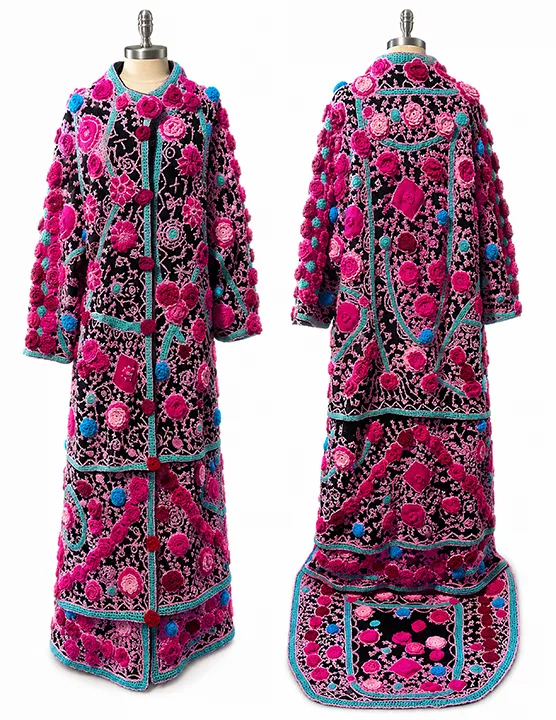
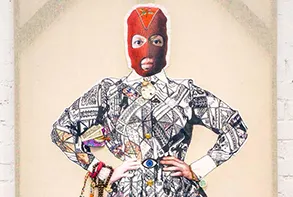
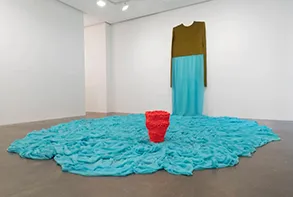
Sikolo the Beautiful, 2023
Mixed media, hand-crocheted floral motifs, and embroidery on an upcycled coat
40 × 20 × 10 in.
Courtesy of the artist
A chance encounter at the Carnival led Milagros Batista to create this wearable artwork. During a community event, Batista met Sikolo Brathwaite, one of the groundbreaking Grandassa Models affiliated with the African Jazz-Art Society & Studios (AJASS), the collective co-founded by her late husband, legendary photographer Kwame Brathwaite, and his brother, activist Elombe Brath. Featured in AJASS’s Naturally fashion shows and related projects, the Grandassa Models helped propel the “Black is Beautiful" movement of the 1960s and 1970s. Batista—whose background includes community organizing and activism—created this piece as a tribute to Sikolo and the movement’s members for their history-making work challenging White supremacist beauty ideals and celebrating natural Black beauty and style.
The handmade floral motifs and embroidery represent craft as acts of service, devotion, and preservation, paying homage to those who ushered in progress for future generations through their advocacy. Today at the Carnival, Batista continues to combine her artistry with social justice work through workshops, helping extend the Carnival’s role in supporting craft-based practices and community upliftment.
MINI ORAL HISTORY