BETTY BLAYTON
(b. 1937, Williamsburg, VA; d. 2016, Bronx, NY)
Betty Blayton was a pioneering figure of abstraction whose phantasmal, ethereal canvases defy easy categorization. Blayton was also a pioneer in the Harlem art scene and in the realm of arts education. She is best known today as a co-founder of The Studio Museum in Harlem where she served as Board Secretary from 1965 to 1977. She also served as co-founder and Executive Director of the Children’s Art Carnival in Harlem from 1969 to 1998. In addition to these major achievements, Blayton acted as a consultant for the Board of Education of the City of New York (1968–1994), served on the board of the Arts & Business Council of New York City (1975–1996), and was a member of the New York City Commission for Cultural Affairs (1979–1988). Her work can be found in the permanent collections of The Studio Museum in Harlem, New York, The Metropolitan Museum of Art, New York, and Spelman College, Atlanta, among other institutions. She was the recipient of such awards as the J. Eugene Grigsby Award for Excellent Contributions in Art Education from the National Arts Education Association (1990), the CBS Martin Luther King, Jr. Fulfilling the Dream Award (1995), and the Lifetime Achievement Award from the Women’s Caucus for Art (2005).
Children’s Art Carnival affiliation: Executive Director, 1969-1997

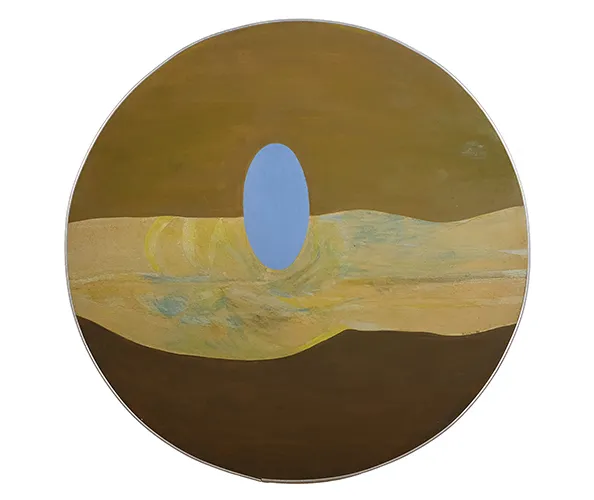
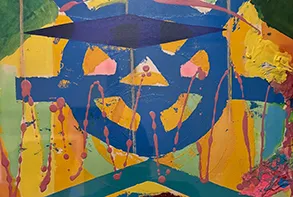
At Onement, 1970
Acrylic on canvas
40 in. diameter
Courtesy of the estate of Betty Blayton
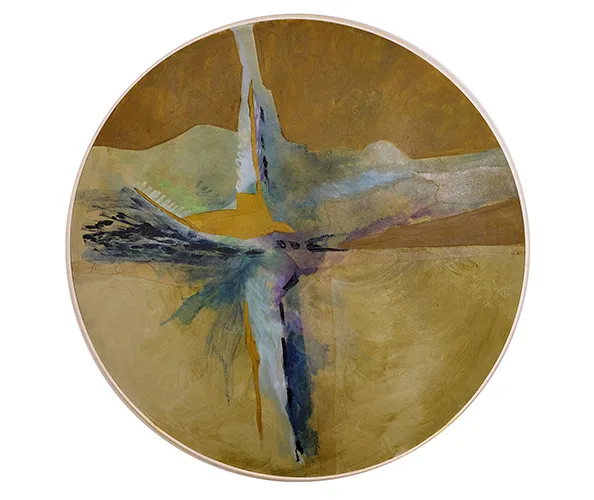
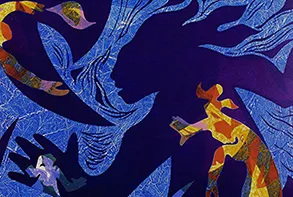
To Soar, 1977
Oil and mixed media on canvas
40 in. diameter
Courtesy of the estate of Betty Blayton
As the Carnival’s visionary leader, Betty Blayton fostered a creative environment grounded in spirituality, meditation, and self-reflective thought. She integrated these ideals into the Carnival’s pedagogical framework, encouraging teaching artists and students alike to reflect, ponder, and dream as part of both creative and personal development. In urging people to look inward, Blayton also drew them toward one another, cultivating an atmosphere in which ideas, inspiration, and energy flowed freely between student and teacher.
Blayton’s own art practice was transformed by the Carnival. She once stated, “Children are wonderful teachers. During the Carnival's early years, I worked with all the different age groups. The four year olds used to blow my mind; everything came in clear because they were still mystics at that age. I have been inspired by the older students, too. Their spontaneous use of color and design is very special.”
These spiritual abstraction works, two of which were created during Blayton’s early years at the Carnival, reflect the influence of children, particularly in their use of color. At Onement reveals an expanding horizon with underlying shades of blue, green, and yellow with a blue form balanced near the center, implying the attainment of inner harmony. Souls Transcending and To Soar employ a broader range of hues, signaling an inner state of freedom.
Although Blayton’s art career was often overshadowed by her cultural activism, recent years have seen renewed interest in her artworks. Blayton is now viewed as a pioneering Black woman abstract artist, who decided during a time of overt depictions of the turbulence of the 1960s and 1970s, to instead portray an inner evolution shaped by a search for spirituality, serenity, and wholeness.