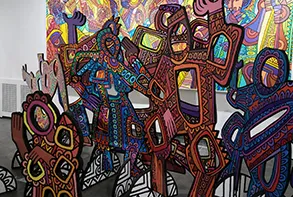
DIONIS ORTIZ
(b. 1979, Harlem, NY; lives and works in Harlem, NY)
Dionis Ortiz is a multimedia artist, community art producer, and educator working in printmaking, collage, and sculpture. Drawing on his Dominican heritage and upbringing in Harlem, he creates geometric, process-based works from found and overlooked materials that celebrate diaspora communities. He has participated in the Artist in the Marketplace (AIM) Program at the Bronx Museum of the Arts, received a Rema Hort Mann Artist Community Engagement Grant, and completed residencies at the Children’s Museum of Manhattan and Sugar Hill Children’s Museum of Art and Storytelling. His work has been featured in The New York Times and included in Estamos bien: La Trienal 20/21 at El Museo del Barrio.
Children’s Art Carnival affiliation: Student (1991–1997), Intermittent Involvement (1997–2001), Administrative and Support Roles (circa 2003–2008), Studio Artist, Gallery Manager/Director and Press & Pull (Carnival-based community print shop) co-development and leadership responsibilities (2021–present)

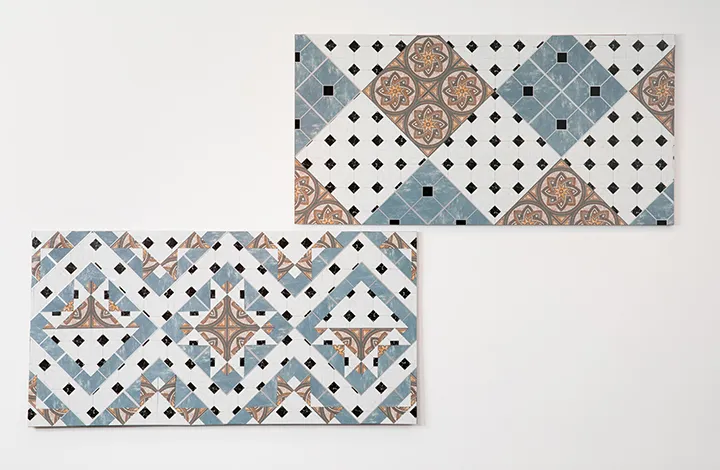
Sunrise to Sunset, 2021
Vinyl tile collage on wood
96 × 162 × ¾ in.
Courtesy of the artist
For Dionis Ortiz, who joined the Carnival as a student after his brother José encouraged him to do so, the experience was defining. “I started to identify myself as an artist because of just how much I enjoyed…being in that environment.”
Ortiz was introduced to abstraction as a relationship between shapes, which teaching artist Martee Levi explained as “...a metaphor for relationships with people, relationships in your family,” Ortiz said. “...where they get along and the patterns and the rhythm feels good, and where it gets disturbed.”
Ortiz carried that metaphor into this tribute to his late father and their daylong collaborative home improvement projects, such as refreshing the floors of their home. The geometric shapes of the upcycled vinyl floor tiles are strategically employed to form a narrative of the labor, time, and devotion his father provided. As noted by the artist, he translates the tiles’ geometric forms and motifs—diamonds, medallions, rhombi, and chevrons—“...to mark a day’s passage…” and “...carry memory from the domestic space into something ceremonial.”
MINI ORAL HISTORY