Lotty Rosenfeld: Disobedient Spaces
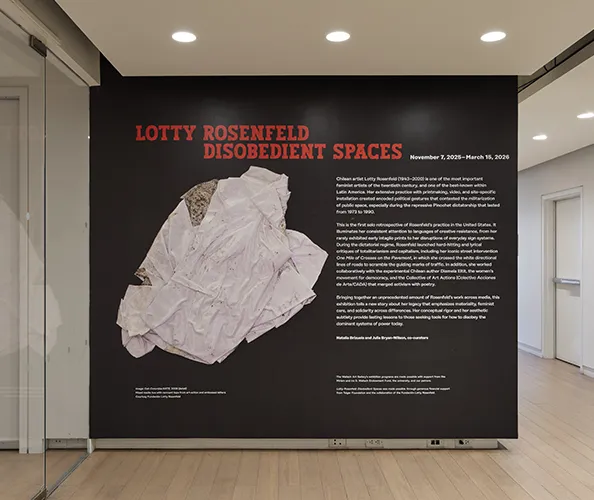
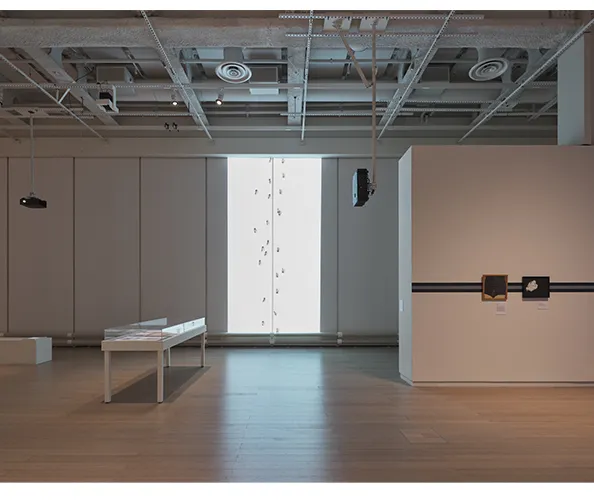
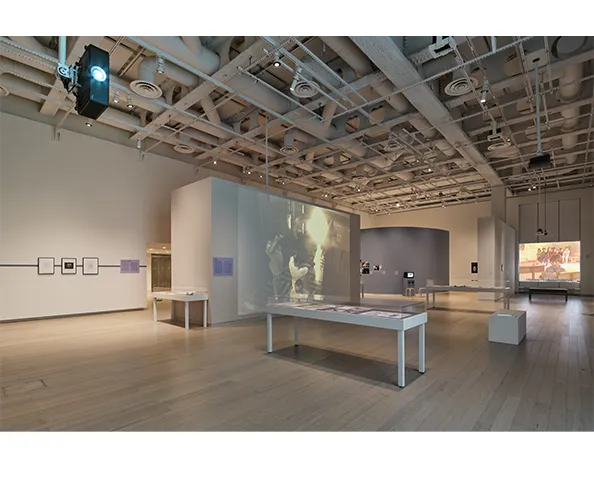
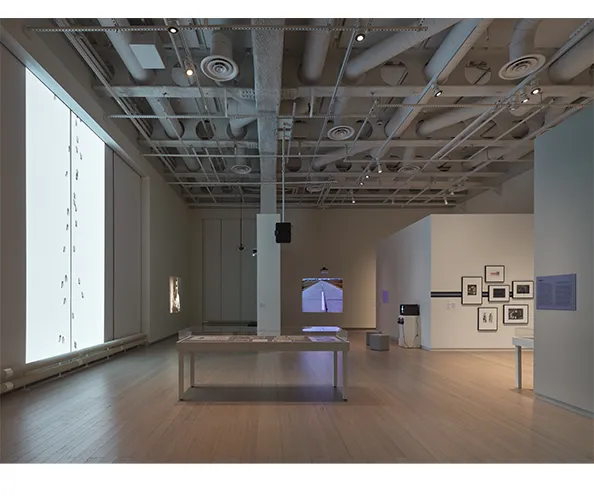
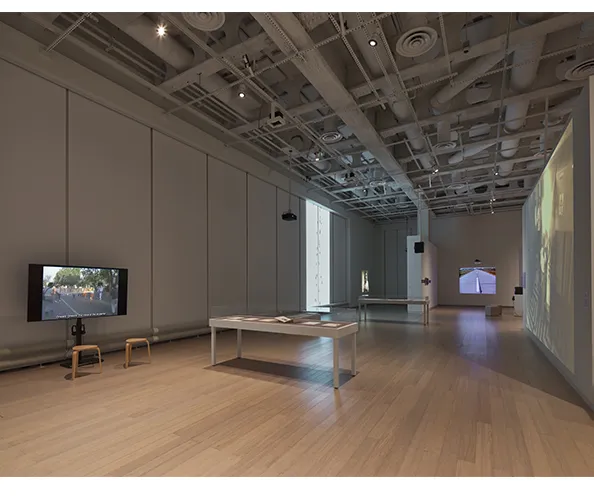
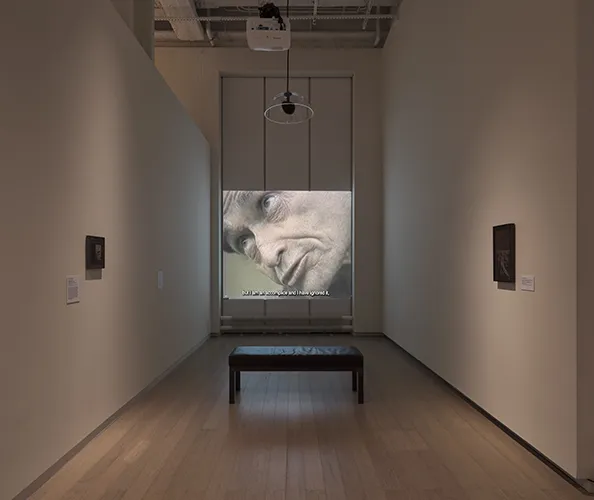
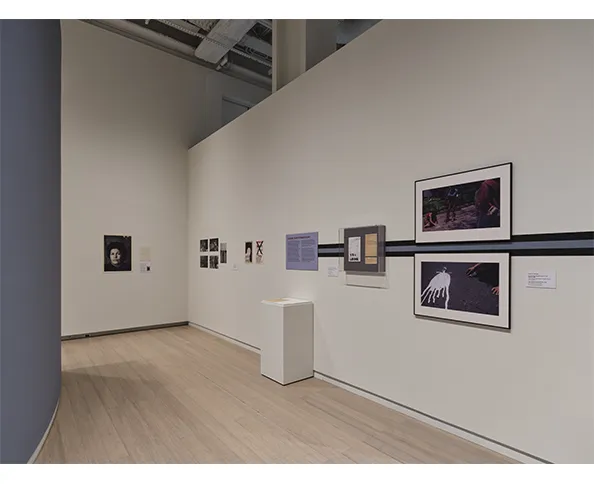
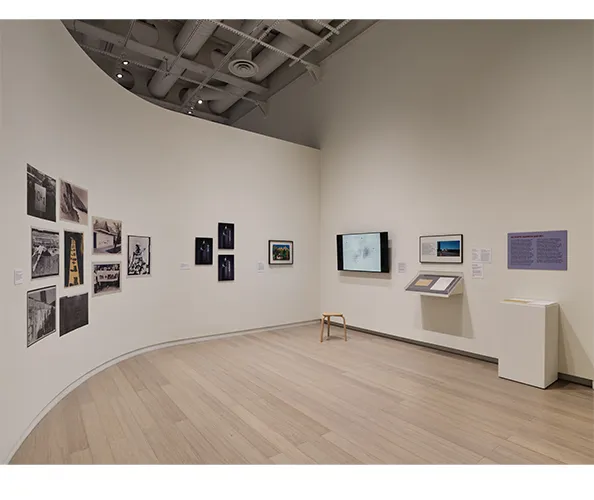
Lotty Rosenfeld: Disobedient Spaces is the first US retrospective of Chilean artist Lotty Rosenfeld (b. 1943, Santiago; d. 2020, Santiago), and presents installation and video projection foregrounding questions of public space, as well as archival documents, prints, and photographs spanning from 1970 to 2019. The exhibition’s title references “disobedient space” as feminist space, an approach that emerged from extensive research and dialogue between the two curators, Julia Bryan-Wilson, a professor at Columbia University, and Natalia Brizuela, a professor at UC Berkeley.
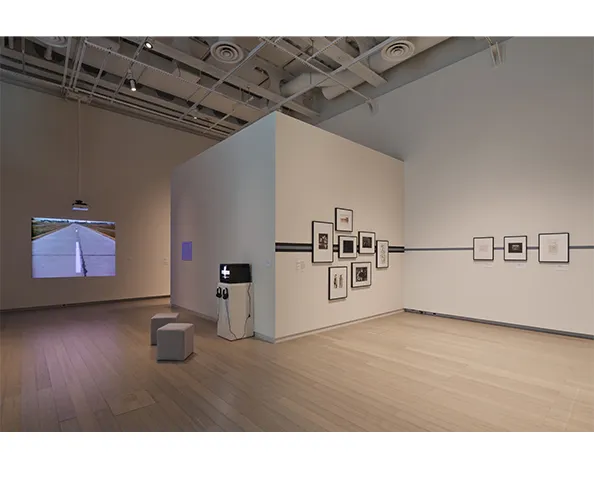
The curators contextualize Rosenfeld’s solo work as well as her collaborations with Colectivo Acciones de Arte (CADA), positioning the artist as a crucial node in a Latin American network that merged activism with poetry. In her wide-ranging feminist art practice, Rosenfeld celebrated the imagination as the antidote to systems of control, be they patriarchal, dictatorial, capitalistic, or colonial. Framed through the lens of care, feminist friendship, and solidarity across difference, the exhibition highlights these aspects of her practice as central to her conceptual strategies. The show also emphasizes an unprecedented range of materialities used by Rosenfeld—including rarely seen intaglio prints, collages from everyday materials, book covers, and serigraphs with thread. Disobedient Spaces foregrounds lesser-known works of intimate collaboration, illuminating Rosenfeld’s relationships with fellow artists and activists. The curators explore how the artist circumvented attempts to police thought, behaviors, and language through the ambiguities inherent in art before, during, and after the Pinochet dictatorship in her native Chile.
SELECTED ARTWORKS IN THE EXHIBITION
Image Carousel with 4 slides
A carousel is a rotating set of images. Use the previous and next buttons to change the displayed slide
-
Slide 1: Lotty Rosenfeld, Una Milla de Cruces Sobre el Pavimento [One Mile of Crosses on the Pavement], 1979. Art action in front of the Moneda Palace, Santiago de Chile, 1979. Courtesy the Lotty Rosenfeld Foundation.
-
Slide 2: Lotty Rosenfeld, La Ultima Cena [The Last Supper], etching on paper, 1973. Courtesy the Lotty Rosenfeld Foundation.
-
Slide 3: Lotty Rosenfeld, Ché from the series El Obstinado Ritual de La Memoria [The Stubborn Ritual of Memory], print on paper with thread, 2007. Courtesy the Lotty Rosenfeld Foundation.
-
Slide 4: Lotty Rosenfeld, Moción de Orden [Point of Order], video projection, 2002. Courtesy the Lotty Rosenfeld Foundation.
![Lotty Rosenfeld, Una Milla de Cruces Sobre el Pavimento [One Mile of Crosses on the Pavement], 1979. Art action in front of the Moneda Palace, Santiago de Chile, 1979. Courtesy the Lotty Rosenfeld Foundation.](/sites/wallach.columbia.edu/files/styles/cu_crop/public/content/Lotty-Rosenfeld_Una%20Milla%20de%20Cruces%20Sobre%20el%20Pavimento_1979.jpg.webp?itok=rl1YJpfl "Lotty Rosenfeld, Una Milla de Cruces Sobre el Pavimento [One Mile of Crosses on the Pavement], 1979. Art action in front of the Moneda Palace, Santiago de Chile, 1979. Courtesy the Lotty Rosenfeld Foundation.")
![Lotty Rosenfeld, La Ultima Cena [The Last Supper], etching on paper, 1973. Courtesy the Lotty Rosenfeld Foundation.](/sites/wallach.columbia.edu/files/styles/cu_crop/public/content/Rosenfeld_La%20ultima%20cena_1979.jpg.webp?itok=14i9cbNs "Lotty Rosenfeld, La Ultima Cena [The Last Supper], etching on paper, 1973. Courtesy the Lotty Rosenfeld Foundation.")
![Lotty Rosenfeld, Ché from the series El Obstinado Ritual de La Memoria [The Stubborn Ritual of Memory], print on paper with thread, 2007. Courtesy the Lotty Rosenfeld Foundation.](/sites/wallach.columbia.edu/files/styles/cu_crop/public/content/Rosenfeld_El%20Che%CC%81_2007.jpg.webp?itok=qtNnMFw3 "Lotty Rosenfeld, Ché from the series El Obstinado Ritual de La Memoria [The Stubborn Ritual of Memory], print on paper with thread, 2007. Courtesy the Lotty Rosenfeld Foundation.")
![Lotty Rosenfeld, Moción de Orden [Point of Order], video projection, 2002. Courtesy the Lotty Rosenfeld Foundation.](/sites/wallach.columbia.edu/files/styles/cu_crop/public/content/Lotty-Rosenfeld_Mocion-de-Orden_2002.jpg.webp?itok=LAjg00I7 "Lotty Rosenfeld, Moción de Orden [Point of Order], video projection, 2002. Courtesy the Lotty Rosenfeld Foundation.")
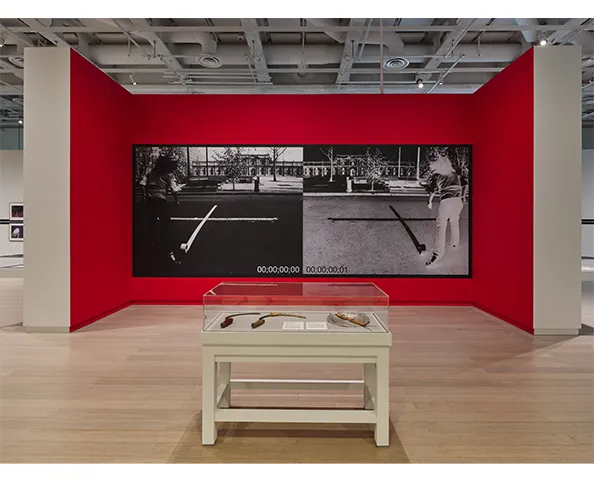
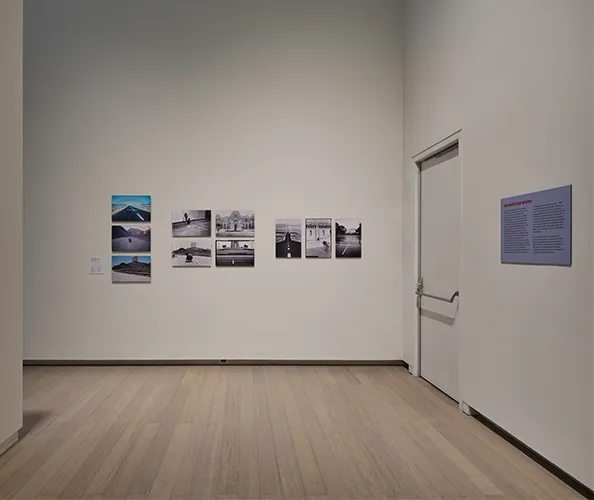
Rosenfeld is known for deploying her expertise as a graphic designer and printmaker to inscribe the phrase “No+” in public spaces. Exhibited works include Una milla de cruces sobre el pavimento [One mile of crosses on the pavement] (1979), in which Rosenfeld used white bandages and tape to alter traffic lines in front of the Chilean Presidential Palace, amongst other sites—actions that questioned state authority. NO+ (“No more”), a phrase developed with the experimental CADA, was taken up across Chile as a call for protest during the Pinochet dictatorship in the 1970s and ’80s.
Rosenfeld was also a member of Escena de Avanzada, a group of avant-garde artists and writers who frustrated authority through semantic disruptions and visual interventions, avoiding direct confrontation but setting an example for the mass demonstrations that would slowly erode the authority of Pinochet’s dictatorial regime. In the bleakest of times, Rosenfeld’s critical, oppositional artistic voice kept alive spaces for dissent, and influenced the cultural and political imagination that ultimately set the stage for successful large-scale resistance movements.
INSTALLATION VIEWS
Image Carousel with 11 slides
A carousel is a rotating set of images. Use the previous and next buttons to change the displayed slide
-
Slide 1: Installation view of the exhibition "Lotty Rosenfeld: Disobedient Spaces" on view at the Wallach Art Gallery from November 7, 2025 - March 15, 2026. Photograph by Olympia Shannon.
-
Slide 2: Installation view of the exhibition "Lotty Rosenfeld: Disobedient Spaces" on view at the Wallach Art Gallery from November 7, 2025 - March 15, 2026. Photograph by Olympia Shannon.
-
Slide 3: Installation view of the exhibition "Lotty Rosenfeld: Disobedient Spaces" on view at the Wallach Art Gallery from November 7, 2025 - March 15, 2026. Photograph by Olympia Shannon.
-
Slide 4: Installation view of the exhibition "Lotty Rosenfeld: Disobedient Spaces" on view at the Wallach Art Gallery from November 7, 2025 - March 15, 2026. Photograph by Olympia Shannon.
-
Slide 5: Installation view of the exhibition "Lotty Rosenfeld: Disobedient Spaces" on view at the Wallach Art Gallery from November 7, 2025 - March 15, 2026. Photograph by Olympia Shannon.
-
Slide 6: Installation view of the exhibition "Lotty Rosenfeld: Disobedient Spaces" on view at the Wallach Art Gallery from November 7, 2025 - March 15, 2026. Photograph by Olympia Shannon.
-
Slide 7: Installation view of the exhibition "Lotty Rosenfeld: Disobedient Spaces" on view at the Wallach Art Gallery from November 7, 2025 - March 15, 2026. Photograph by Olympia Shannon.
-
Slide 8: Installation view of the exhibition "Lotty Rosenfeld: Disobedient Spaces" on view at the Wallach Art Gallery from November 7, 2025 - March 15, 2026. Photograph by Olympia Shannon.
-
Slide 9: Installation view of the exhibition "Lotty Rosenfeld: Disobedient Spaces" on view at the Wallach Art Gallery from November 7, 2025 - March 15, 2026. Photograph by Olympia Shannon.
-
Slide 10: Installation view of the exhibition "Lotty Rosenfeld: Disobedient Spaces" on view at the Wallach Art Gallery from November 7, 2025 - March 15, 2026. Photograph by Olympia Shannon.
-
Slide 11: Installation view of the exhibition "Lotty Rosenfeld: Disobedient Spaces" on view at the Wallach Art Gallery from November 7, 2025 - March 15, 2026. Photograph by Olympia Shannon.